
Your gym 2.0 at home
How to set up your own gym
What can you expect from this article?
In the following article, I will explain everything you need to set up your own home gym. We will also talk about how much it should cost, how you can save money when buying equipment, and what you might even be able to build yourself. I hope you enjoy this article. Please feel free to send me feedback or ask me questions by email at mario@mario-klintworth.de if you need help.
What kind of gym should we build for you?
That depends entirely on where you want to train. Do you want to train indoors or outdoors? Depending on your choice, the equipment may need to be weatherproof. We are primarily assuming a classic indoor gym setup in your apartment, basement, or exercise room.
What is your budget or how much money do you have available for your own gym?
You should also ask yourself this question before you really get started. What is your approximate budget? Are there things you can build yourself? Would you prefer to buy everything ready-made? There are now compact training stations for the home that offer a range of equipment. Everything has advantages and disadvantages, but I can reassure you that we don't need much for a good home gym.
What equipment do you need for your gym?
Now that we've addressed a few questions, I'll suggest different options in the following section and give you a rough idea of the prices involved. For your own gym in your child's room or training room, you don't need much additional equipment besides a few basics. As a teenager, I found that simple weight plates, barbells, and a basic weight bench were the most useful. However, to create an optimal program according to today's training standards, you'll need a little more than I had in my home gym in my childhood bedroom over 25 years ago.
What does the optimal home gym workout look like?
A good workout always consists of preparation, a main workout, and follow-up. You already know this from your school days. The teacher made sure you warmed up properly. Only then did the actual training, sports, exercises, or disciplines begin.
Here is a simple example of how it is done in athletics or soccer:
The preparation consists of running A, B, C and various running, jumping, stretching, and loosening exercises before the actual training begins. After the training, there is a relaxed cool-down and possibly another stretching exercise.
You determine the structure of your training yourself and are therefore responsible for your warm-up in order to prepare your body optimally for training. The follow-up is just as important and is your responsibility if you want to train injury-free and still be able to move the next day.
How do I warm up for bodybuilding?
In bodybuilding, this is just as important as in ball sports or athletics. In bodybuilding, ideally, after warming up in the gym, we do a few mobility exercises with our own body and a few exercises with resistance bands. This prepares our muscles and joints for the strain, so that the risk of injury during training is zero. So, all you may need is a pair of running shoes, a gym mat, and a few resistance bands to keep your warm-up routine up to date. Never forget, warming up is key!
What equipment do you need for your home workout in your own gym?
For actual bodybuilding or strength training, it is perfectly sufficient if your home gym has a barbell, a dumbbell set, and a flat bench for now. With this equipment, you can already perform all the basic exercises, which are known to be the most effective for building muscle. Always keep two rules in mind:
- Rule 1: Weight beats function!
If you lift heavy weights during your workout, this exercise will always be more effective than an exercise where you only move a small amount of weight. Example: triceps extensions with dumbbells behind your head vs. dips on parallel bars or a bench. You will always use less weight with the dumbbell exercise than with classic dips. With dips, you are not only lifting a large part of your body weight, but also engaging many other muscles, such as the shoulder and chest muscles. Dips will therefore always activate more muscles than a comparable exercise that isolates the triceps.
- Rule 2: No strength, no muscles!
In other words, strength turns into muscle. This means that it's not lots of repetitions that shape your muscles, but only cleanly executed training with heavy weights! Continuity is the key here, because you can only build quality muscle by working with heavy weights over long periods of time.
How many weight plates do you need in your home gym?
Your training status determines the equipment you need. If you are already well trained, you will need quite a few weight plates. If you are just starting out, 2 x 2.5 kg, 2 x 5 kg, and 2 x 10 kg will probably suffice for now.
Practice: You should definitely pay attention to this!
Training is not only about the actual exercise but also about the execution, in this case specifically the handling of the weights. This means that the exercises are often not complicated at all, but rather the picking up and handling of the barbells without a training partner. I have trained without a training partner for most of my life. In fact, I have hardly ever trained with one. It is extremely helpful to have a weight bench with a barbell rack or to build a reliable structure for this purpose.
Tip: My little building instructions:
For me, a construction site lighting bracket made from car tires and a welded iron bar worked very well at times. But two water crates connected with duct tape and a carved indentation for the handles can also function very well as a barbell rack.
Once your training picks up speed and you get stronger, I would definitely recommend installing a pull-up bar or ceiling mount for loops or handles so that you can do pull-ups or similar exercises with different grip widths.
Tip: My little building instructions:
If you have a sturdy ceiling, beam, or patio ceiling to which you can attach a suitable hook, you can hang not only a punching bag but also a simple pulley for a pulley block. You can then use this to perform triceps extensions or latissimus exercises.
I did this on my patio during the coronavirus pandemic to train my triceps. Another important note at this point when it comes to weight plates or dumbbells. Be sure to get a rubber mat from the hardware store to store the weight plates safely. Such weights can cause very unsightly damage to parquet or tiles and also provoke the neighborhood.
In my opinion, the following equipment should not be missing from your home gym:
- The sling trainer:
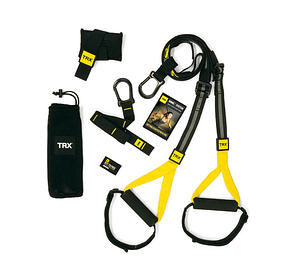
picture copyright: TRX Training https://bit.ly/2HABW6L
It doesn't matter which brand you choose. Just make sure it has good reviews. The sling trainer can not only help you warm up, it's also great for training your abs and provides a flexible alternative to the gym when you're on vacation.
- The equalizer:
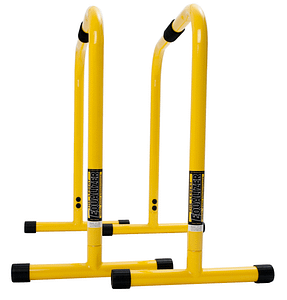
picture copyright: Lebert Equipment https://bit.ly/2IWt7nY
The Equalizer is a device that allows you to perform various exercises, including dips and gymnastics. I also find this device useful in step 2 to further expand your training program. If you want to expand your equipment, I recommend additional dumbbell sets for more variety and less conversion with weight plates. My tip: In this context, look for quick-release fasteners and clamping rings/clamps so that you don't have to screw or turn every time you change weights.
- The safety bar or SZ bar:
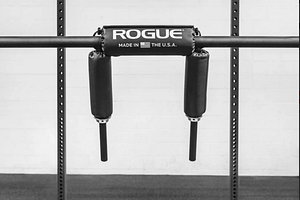
picture copyright: Rogue https://bit.ly/3joqRSZ
I would also purchase an S-Z bar for more exercise variation and a safety bar for safer and more effective squats. Leg training is particularly important for the development of your entire body, so never skip it! If you would like to learn more about how and why leg training can also give you a more muscular upper body, just send me an email.
What you definitely don't need:
All the nonsense you can buy in many fitness stores or online shops, such as push-up handles, expanders, and the latest EMS abdominal trainers. Save your money for such knick-knacks. Instead, expand your equipment and buy a squat rack or an adjustable weight bench so that you can train at different angles.
How much does your own gym actually cost?
Now it gets interesting. As I said, you don't need much to get started. If you're already as strong as an ox, the additional weight plates you need will cost a little more than for a beginner. But you can vary or change the weights, and you don't need to put a lot of weights on every bar you use.
Here is an initial overview including current prices and origin:
- Resistance bands: Set approx. $50 on Amazon
- Sling trainer: approx. €20 at discount stores (Aldi, Netto, Lidl, etc.) or Amazon
- Adjustable bench, new approx. €150 on eBay
- Dumbbell set: 10 kg, 2 dumbbells, 30 mm, new approx. €50 on eBay
- Trading days: New 30 mm approx. $45 on eBay
- S-Z barbell bar: new 30 mm approx. $45 on eBay
- Weight plates: 30 mm set, 2 x 10 kg, 2 x 5 kg, 2 x 2.5 kg rubberized, new: total price approx. €55 on eBay
- Pull-up bar: for the wall or door frame New between $20 and $40 on eBay
- Gym floor mats: approx. $30 at a hardware store or on Amazon
- Rubber mats or gym mats: approx. $20 at hardware stores or discount grocery stores
Total price to get started: approx. $500
Please note: The prices listed above are 100% for new items, resulting in a price of approx. $500 for a small home gym. However, if you are looking for used equipment from friends, acquaintances, or on eBay classifieds, you can certainly get some, or even all, of the equipment for half the price, approx. $350. If you then share the purchases with a friend, colleague, neighbor, or training partner, the investment for your own gym shrinks to pocket money.
What are the advantages of having your own home gym?
- You can train anytime
- No travel time, no traffic jams, no parking problems
- Training outfit, fresh air, music taste beyond competition
- No spectators
- No extra costs for drinks, parking, showers, etc.
Click here for my homework videos: https://bit.ly/3oNTJYJ
I hope my tips have been helpful. If you have any questions or would like to know where to get good equipment at a reasonable price, feel free to email me with your questions. I wish you every success and hope you enjoy your own home gym. Train hard and smart, Mario